Ali Baba and the Forty Thieves
A woodcutter discovers the secret of a cave and, with the help of clever Marjana, honesty defeats greed.
An original short adaptation inspired by the tale Ali Baba and the Forty Thieves, which Antoine Galland added to The Thousand and One Nights in the 18th century from the oral stories of the Syrian storyteller Hanna Diyab, with an ending free of violence.
Traditional tales come in many versions; this one is ours.
Listen to the story
Follow the narration with the story text below.
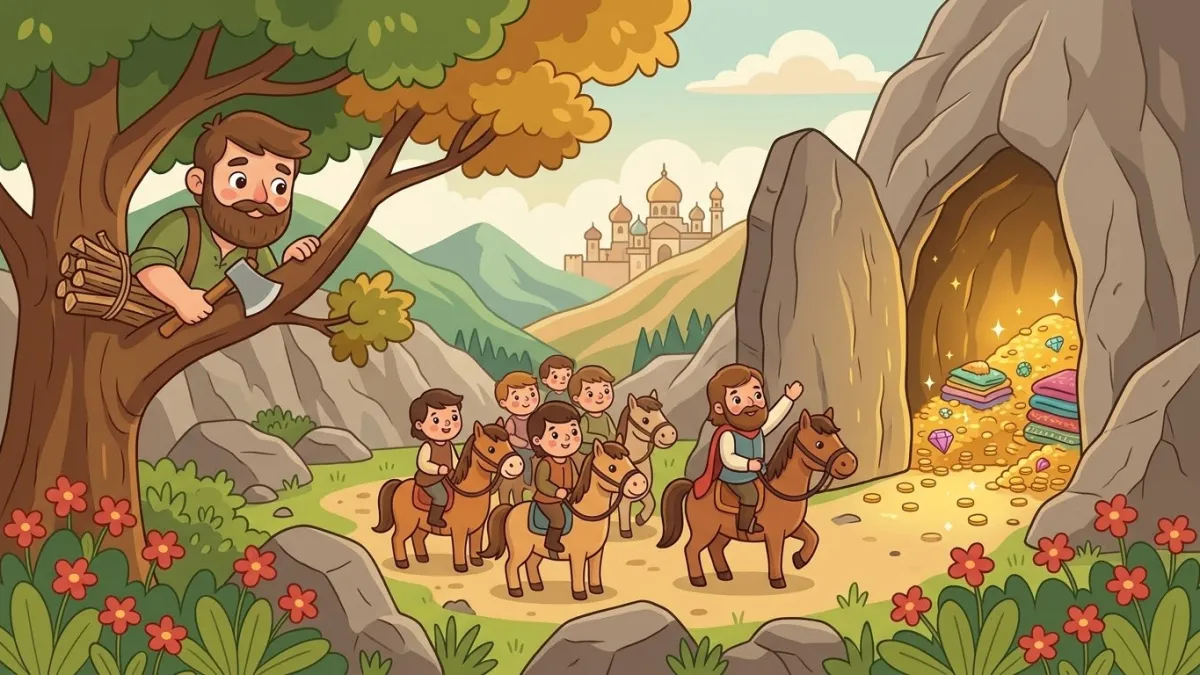
Ali Baba was a woodcutter who lived with his wife in a humble little house near a city of markets and caravans. He worked hard every day in the forest, and although he earned little, he was honest and generous. His elder brother, Cassim, on the other hand, was rich and very ambitious.
One day, while he was cutting wood, Ali Baba saw a band of forty horsemen approaching. He hid among the branches of a tree. The leader stopped in front of a large rock and said aloud: “Open, Sesame!” The rock opened like a door, and the riders went in with their bags.
Soon afterwards they came out, and the leader said: “Close, Sesame!” The rock went back into place. When the riders had gone, Ali Baba, his heart beating hard, came forward and repeated the words. The rock opened, and inside he found a cave full of gold coins, jewels and precious cloth. He understood that they were treasures stolen from travellers of the caravans.
Ali Baba took a few bags of coins to help his family and promised himself that, when he could, he would return what had been stolen to its owners. He went home in secret. But his wife, who wanted to measure the coins, borrowed a scale from her sister-in-law, and so the secret reached Cassim’s ears.
Cassim, moved by greed, made his brother tell him everything. He ran to the cave and said: “Open, Sesame!” Inside he stuffed his pockets with so much gold that, when he wanted to leave, he forgot the magic words! He tried “Open, Barley!” and “Open, Wheat!”, but the rock would not move.
As night fell, Ali Baba, worried about his brother, went to the cave and spoke the words. The rock opened, and he found Cassim sitting among the coins, very frightened. “Forgive me,” said Cassim, “greed clouded my mind.” Ali Baba hugged him, and they went home together.
When the forty horsemen returned, they saw that coins were missing and that there were footprints on the ground. “Somebody knows our secret,” said the leader. They followed the footprints to Ali Baba’s house and marked it with a chalk cross, so as to come back at night.
But Marjana, Ali Baba’s clever maid, saw the mark. Without a word, she took a piece of chalk and drew the same cross on every door in the street. When the thieves returned, they could not tell which house it was, and went away confused.
Then the leader came up with a new plan. He pretended to be an oil merchant and arrived at Ali Baba’s house with a caravan of mules carrying big jars. “I am looking for lodging for myself and my goods,” he said. Ali Baba, hospitable, invited him in. But inside the jars hid the rest of the thieves.
Marjana, who went to fetch oil for the lamp, heard whispers inside a jar: “Is it time yet?” Unafraid, she answered in a deep voice: “Not yet.” She understood the plan. Very carefully and in silence, she tied down the lids with ropes and alerted the city guard.
That night, the false merchant gave the signal for the thieves to come out, but nobody came out, and the guards, entering through the door, surrounded him. Marjana, dressed as a dancer, came into the room to distract him with a dance, and when he was careless, the guards arrested him. The forty thieves were taken before the judge, and the city was at peace again.
Ali Baba returned the stolen treasures to the caravans’ owners, and thanked Marjana for her courage and intelligence: he gave her her freedom and made her part of his family. Cassim learned to share. And the words “Open, Sesame” were told all over the city as a reminder that cleverness, honesty and loyalty open more doors than greed.